By : Editorial Department of Elegant Import & Export Co., Ltd.
How to Import a Used Car from Japan: Complete Guide 2026
Japan is one of the world's largest exporters of used vehicles, and for good reason. Japanese used cars are renowned for their reliability, low mileage, and excellent condition — making them highly sought after in Africa, Southeast Asia, the Caribbean, the Pacific Islands, and beyond.
Whether you are a first-time buyer, a car dealer looking to stock quality vehicles, or a fleet operator expanding your operations, this guide walks you through every step of the import process — from choosing the right vehicle to clearing customs in your country.
Quick Summary: Importing a used car from Japan involves 9 key steps — checking your country's import regulations, setting your budget, selecting a licensed exporter, choosing your vehicle, understanding shipping terms, making payment and receiving export documents, shipping, clearing customs, and registering locally. The entire process typically takes 4 to 8 weeks depending on your destination.
Step 1: Check Import Regulations in Your Country
Before you do anything else, confirm what your country allows. Import rules vary significantly by nation and getting this wrong can be costly.
Key things to check:
- Age restrictions: Many countries only allow vehicles under a certain age — commonly 5, 8, or 10 years old
- Steering: Some countries only allow Right Hand Drive (RHD), others only Left Hand Drive (LHD)
- Emissions standards: Some markets require Euro 4 or higher compliance
- Import duty rates: Know what you will pay in duty and VAT before committing to a purchase
- Engine size restrictions: Some countries charge duty based on CC rating or restrict certain engine sizes
Your country's customs authority website or a local customs agent can provide accurate current information.
Important: These regulations are not just formalities — they are enforced at the pre-shipment inspection stage before the vehicle leaves Japan. Certified inspection bodies such as JVIC, AutoTerminal, and Bureau Veritas verify that the vehicle meets your country's import requirements before issuing an inspection certificate. If the vehicle does not comply — wrong age, wrong steering, wrong emissions standard — the inspection certificate cannot be obtained and the vehicle cannot be shipped to your destination. This is why confirming your country's regulations before purchasing is essential.
Step 2: Set Your Budget
Your total cost of importing a vehicle from Japan is more than just the vehicle price. Make sure you account for all costs before committing.
| Cost Item | Notes |
|---|---|
| Vehicle FOB Price | The price of the car loaded onto the ship in Japan |
| Ocean Freight | Cost to ship to your destination port |
| Marine Insurance | Typically 1-2% of vehicle value — strongly recommended |
| Import Duty | Varies significantly by country — can range from 10% to over 100% of CIF value depending on your country's tax structure |
| VAT / Sales Tax | Applied in most countries on top of duty |
| Port Handling Charges | Local port fees at destination |
| Customs Agent Fee | Local agent to handle clearance paperwork |
| Local Registration | Plates, roadworthy certificate, local taxes |
Tip: The additional costs on top of the vehicle FOB price vary enormously by country. Some countries charge as little as 10-15% in total, while others have a complex multi-layered tax structure where total duties and taxes can exceed 100%-300% of the CIF value. Always verify the exact costs with a licensed customs agent in your country before committing to a purchase — never rely on a general estimate.
Step 3: Choose a Licensed Japanese Exporter
This is one of the most important decisions in the entire process. A trustworthy, licensed exporter protects your money and ensures your vehicle arrives as described.
What to Look for in an Exporter
- Licensed exporter: Must be a registered, licensed vehicle exporter in Japan
- Auction membership: Should be a member of major auction houses (USS, IAA, TAA)
- Transparent pricing: Clear FOB pricing with no hidden fees
- Auction sheet provided: Supplies the original auction inspection sheet for any vehicle sourced through auction
- Pre-shipment photos: Sends detailed photos before shipping
- Export documentation: Handles all Japanese export paperwork correctly
- Track record: Has verifiable history of exporting to your country or region
Warning: Be cautious of exporters who cannot provide the auction sheet for an auction-sourced vehicle, ask for full payment with no documentation, or offer prices that seem unrealistically low. Always verify the exporter's credentials before sending any payment.
Step 4: Choose Your Vehicle
Japan has one of the most extensive used vehicle markets in the world. When buying from a Japanese exporter, vehicles are typically sourced through one of three channels — each equally capable of producing a high quality vehicle.
Finding Your Vehicle — Two Ways to Buy
The first place to start is your exporter's website stock list, where available vehicles are listed with photos, specifications and pricing. If you find a vehicle that meets your requirements, you can proceed to purchase directly.
If you cannot find what you need in the current stock, don't worry — this is very common, especially for specific makes, models, year ranges, or specifications. Simply contact your exporter with your requirements and budget. Your exporter will then search Japan's auction network and local dealer channels on your behalf and come back to you with matching options and pricing.
How Japanese Used Vehicles Are Sourced
1. Japanese Auto Auctions (USS, IAA, TAA, JU)
A very common sourcing channel. Major auction houses independently inspect and grade every vehicle before sale, providing a detailed auction sheet that documents the vehicle's condition, mileage, body condition, and any known issues. If your vehicle was purchased through auction, your exporter can provide the original auction sheet as a reference for the vehicle's condition at the time of sale.
2. Direct Purchase from a Japanese Vehicle Owner or Local Dealer
Some vehicles are purchased directly from their Japanese owner (a private individual) or sourced from a local used car dealer within Japan. In either case there is no auction sheet, as the vehicle was never put through an auction. This does not in any way reflect the quality of the vehicle. Many privately owned Japanese vehicles are exceptionally well maintained and come with full service history, and Japanese dealer standards are generally high. Your exporter will provide documentation, photos and a self assessment to support the vehicle's condition.
Note: The absence of an auction sheet does not mean a vehicle is lower quality. Auction sheets are simply a feature of the auction channel — they do not exist for dealer or privately sourced vehicles regardless of condition. What matters is that your exporter is transparent, provides supporting documentation, and has a trustworthy track record.
Understanding Japanese Auction Grades
For vehicles purchased through auction, every vehicle receives an independent condition grade from the auction house. This is a useful reference tool when available.
| Grade | Condition | What to Expect |
|---|---|---|
| Grade 5 / S | Excellent | Brand new or near new condition, no defects. Grade S is used by some auction houses specifically for brand new vehicles |
| Grade 4.5 | Very Good | Minor scratches only, excellent overall |
| Grade 4 | Good | Small scratches or dents, clean interior |
| Grade 3.5 | Above Average | Some light body repairs, good mechanicals |
| Grade 3 | Average | Noticeable wear, minor repairs may be needed |
| Grade R / RA | Repaired | Previously repaired accident damage |
Recommendation: For auction vehicles, Grade 3.5 to 4.5 offers the best value — good condition at competitive prices. For non-auction vehicles, your exporter will provide documentation, photos and a self assessment to support the vehicle's condition.
Step 5: Understand Shipping Terms (FOB, C&F, CIF)
When your exporter quotes you a price, it will usually be in one of three formats. Understanding these terms is essential before agreeing to any purchase.
| Term | What's Included | What's NOT Included |
|---|---|---|
| FOB Free On Board |
Vehicle price + all costs incurred in Japan up to the point of loading onto the ship — including port charges, customs clearance fees, export documentation fees, and any mandatory pre-shipment inspection costs | Ocean freight, marine insurance, destination port charges, import duty, local charges |
| C&F Cost & Freight |
FOB + ocean freight to your destination port | Marine insurance, destination port handling charges, import duty, local charges |
| CIF Cost, Insurance & Freight |
FOB + ocean freight + marine insurance | Destination port handling, import duty, local charges |
CIF is recommended for most buyers — it includes marine insurance which protects your investment during transit. Always confirm which term applies to your quote before making payment.
Step 6: Payment and Documentation
Once you have agreed on the vehicle and price, your exporter will provide a proforma invoice. Payment is typically made by bank transfer (T/T — Telegraphic Transfer) to the exporter's business account. However, depending on your country's import regulations or your own bank's requirements, payment may need to be made via Letter of Credit (LC). Your exporter will advise the accepted payment methods and your local bank or customs agent can confirm what is required in your country.
Important — Bank Transfer Safety: When making a T/T payment, always verify that you are using the correct official bank details of your Japanese exporter. Reputable exporters display their official company bank details on their website — always cross-reference the bank details on your invoice against those published on the exporter's official website before transferring any funds. Never transfer payment to a personal bank account or any account that does not match your exporter's official published bank details. Your exporter cannot be held liable for funds transferred to any third party account. If you receive any unexpected email or message asking you to send payment to a different account, treat this as a serious red flag and contact your exporter directly by phone to verify before proceeding.
Documents You Will Receive After Payment & Shipment
Once payment is received and your vehicle has been shipped, your exporter will send you the following key documents. In most cases digital copies sent via email are sufficient to clear your vehicle at the destination port — however if your country or customs agent requires original physical documents, your exporter can courier them to you via DHL, UPS, EMS or similar international courier services.
- Export Certificate (De-registration Certificate): Proof that the vehicle has been officially deregistered in Japan — essential for import clearance at your destination port. Since late 2020, Export Certificates can be verified online through the Japan Inspection Organization, meaning a digital copy is accepted in most cases and is sufficient for customs clearance.
- Bill of Lading (B/L): The official shipping document issued by the shipping line. This is your proof of ownership during transit and is required to release the vehicle at the destination port. Your exporter will send this once the vessel has departed Japan. In many cases — particularly where full payment has been completed — the exporter will surrender the original B/L to the shipping line on your behalf. In this case you will receive a Copy B/L or a Surrendered B/L copy, which is sufficient to release the vehicle at the destination port without waiting for an original physical document to arrive by courier.
- Commercial Invoice: The official invoice showing the vehicle details, declared value, buyer and seller information — used by customs to assess import duty.
- Packing List: Details of the shipment contents, required as part of the customs clearance documentation. Note that a Packing List is applicable for container shipments only — it is not required for RO-RO shipments.
- Inspection Certificate: Where a mandatory pre-shipment inspection is required by your country's regulations, the inspection certificate issued by the certifying body (such as JVIC, AutoTerminal, or Bureau Veritas) will be provided. Since late 2020, inspection certificates can also be verified online, and digital copies are accepted for customs clearance in most cases.
Note: Since the end of 2020, both Export Certificates and Inspection Certificates issued in Japan can be verified online, significantly reducing the risk of document forgery. In most cases a digital copy of your documents sent by email is all you need to clear your vehicle at the destination port. If original physical documents are required, your exporter can courier them to you via DHL, UPS, EMS or a similar international courier.
Step 7: Shipping Your Vehicle
Japanese used vehicles are shipped using two main methods. Your exporter will advise the most appropriate option for your destination and vehicle type.
RO-RO (Roll-On Roll-Off)
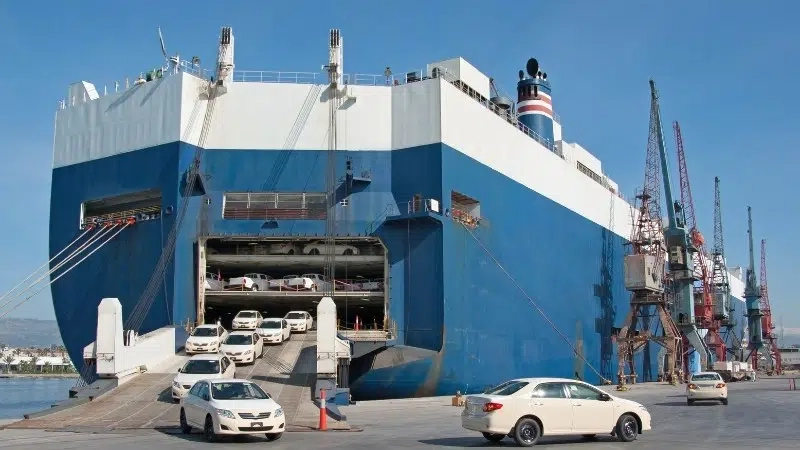
The vehicle is driven onto a specialised car carrier ship and secured for the voyage. This is the most common and cost-effective method for single vehicles and is widely used for all types of vehicles. Note that RO-RO is only possible if the vehicle is in a driveable condition — if you are importing a non-driveable vehicle, for example one purchased for spare parts, RO-RO is not an option and container shipping must be used instead.
Container Shipping
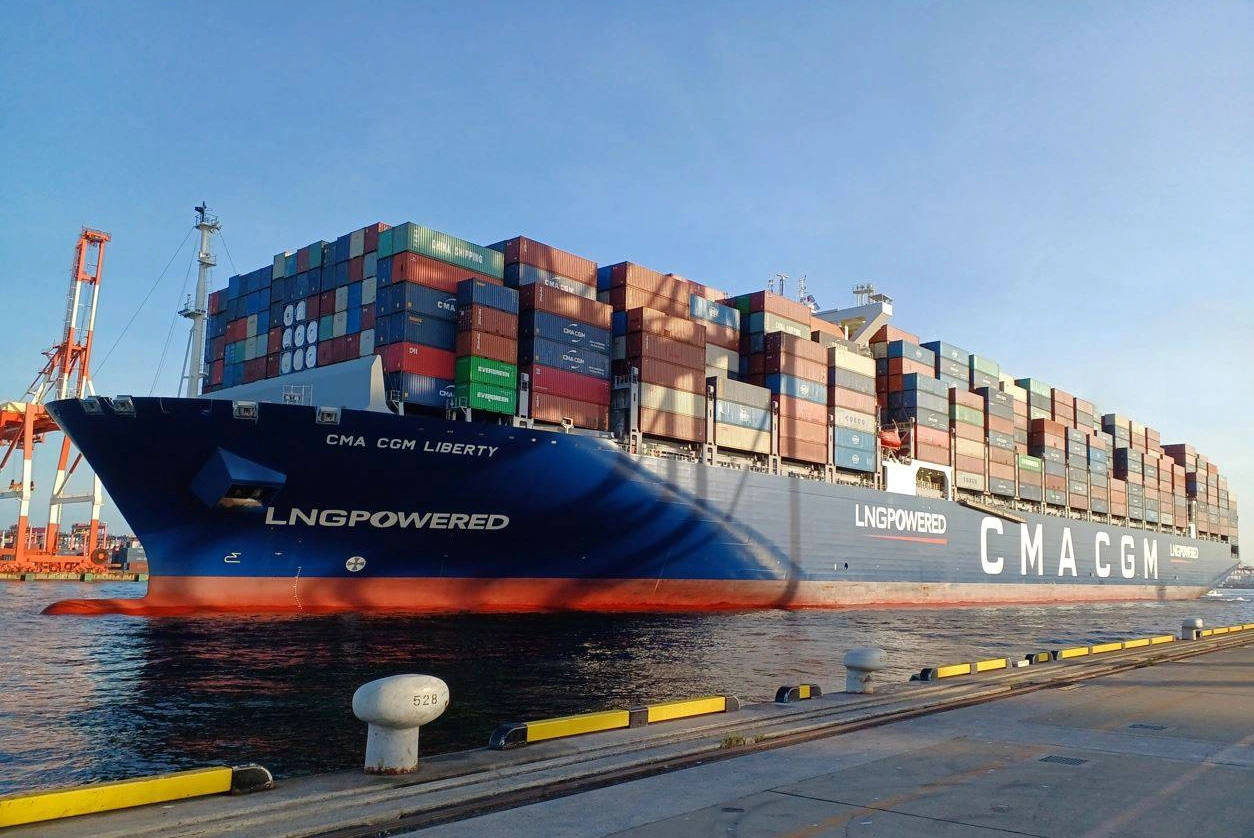
The vehicle is loaded inside a 20ft or 40ft shipping container. This offers greater protection from the elements and is preferred for high-value vehicles, motorcycles, or when shipping multiple vehicles together in one container to reduce costs.
Step 8: Customs Clearance at Your Destination
When your vehicle arrives at the destination port, you or your appointed customs agent will need to clear it through customs. This process varies by country but generally involves the following steps.
- Submit documents: Provide all shipping documents to your customs agent
- Vehicle inspection: Customs may inspect the vehicle physically
- Duty assessment: Customs calculates the applicable import duty based on CIF value, engine size, or age depending on your country's rules
- Pay duties and taxes: Settle all applicable import duty, VAT and any other local levies
- Release order: Once payment is confirmed, customs issues a release order
- Port release: Your agent collects the vehicle from the port on your behalf
It is strongly recommended to use a licensed local customs agent who is experienced with vehicle imports. Their fee is typically modest and saves significant time and errors.
Step 9: Local Registration
After customs clearance, your vehicle will need to be registered locally before it can be driven legally on public roads. Requirements vary by country but typically include a roadworthy/safety inspection, local registration, number plates, and local insurance.
Ready to Import a Japanese Used Vehicle?
At Elegant Import & Export, we are a fully licensed Japanese vehicle exporter with over 20 years of experience. We handle everything from vehicle selection to export documentation — making the import process as smooth as possible for buyers worldwide.
Why Choose Us:
- Licensed Japanese vehicle exporter & member of USS, IAA and TAA auctions
- Over 20 years of industry experience
- Full vehicle details provided / easy to navigate website
- Handles pre-shipment inspection and all other related documentation
- Competitive FOB, C&F and CIF pricing
- Worldwide shipping to 90+ countries
Final Thoughts
Importing a used car from Japan is a straightforward process when you work with the right exporter and understand the steps involved. Japan's vehicle export industry is well-established, transparent, and supported by one of the most rigorous used vehicle grading systems in the world.
The key to a successful import is preparation — knowing your country's regulations, setting a realistic total budget, and choosing a licensed, experienced exporter who provides full documentation and transparent pricing.
Ready to get started? Browse our real-time stock list of quality Japanese used vehicles at competitive FOB prices — cars, SUVs, vans, trucks, buses and luxury vehicles available for worldwide export. View Stock List ›
Frequently Asked Questions
The entire process typically takes 4 to 8 weeks from the time of purchase. This includes vehicle preparation and inspection in Japan (1-2 weeks), ocean shipping (2-5 weeks depending on your destination), and local customs clearance (1-2 weeks). Nearby destinations like Southeast Asia and Australia are faster; Caribbean and African destinations may take longer.
After payment and shipment, your exporter will provide the key documents needed for customs clearance — the Export Certificate (deregistration certificate from Japan), Bill of Lading, Commercial Invoice, Packing List, and Inspection Certificate where required by your country. Since late 2020, both Export Certificates and Inspection Certificates can be verified online in Japan, so digital copies are accepted for customs clearance in most cases. If your customs agent requires original physical documents, your exporter can courier them via DHL, UPS or EMS.
RO-RO (Roll-on Roll-off) shipping is generally the cheapest method for importing a single vehicle from Japan. Container shipping costs more but offers better protection for the vehicle. For multiple vehicles, a shared container can be cost-effective. Your exporter will advise the best method for your destination.
Yes, most countries charge import duty and VAT on imported vehicles. The rate varies enormously by country — some countries charge a relatively modest 10-15% in total, while others have complex multi-layered tax structures where the combined duty, excise, and VAT can exceed 100%-300% of the CIF value. Sri Lanka for example has multiple tax layers including customs duty, excise duty, and VAT that can stack significantly depending on engine size and vehicle value. Always check your country's customs authority or consult a licensed local customs agent for the current rates before purchasing.
Most countries allow the import of used Japanese vehicles, but there are restrictions to be aware of. Common restrictions include age limits (some countries only allow vehicles under 5 or 8 years old), right-hand drive vs left-hand drive requirements, and emissions standards. Your exporter or local customs agent can advise what is permitted in your country.
Yes, it is very common and generally safe when you use a reputable licensed exporter. For auction vehicles, your exporter can provide the original auction sheet — an independent condition report covering body grades and mechanical notes. For vehicles sourced directly from a Japanese owner or local dealer, your exporter will provide photos and a self assessment to support the vehicle's condition. In all cases, choosing an exporter with a strong track record and transparent documentation practices is the key to a safe purchase.
FOB stands for Free On Board. The FOB price covers the cost of the vehicle plus all charges to load it onto the ship at the Japanese port. It does not include ocean freight, insurance, or destination charges. When comparing prices from exporters, always check whether the price quoted is FOB or includes freight (C&F or CIF).
For vehicles purchased through a Japanese auction, your exporter can provide the original auction sheet which rates the vehicle's condition (Grade 3 to 5) and documents body and mechanical condition. For vehicles sourced directly from a Japanese owner or dealer — where no auction sheet exists — your exporter will provide photos and a self assessment to support the vehicle's condition. In both cases, many destination countries require a mandatory pre-shipment inspection by a certified body such as JVIC, AutoTerminal, or Bureau Veritas before the vehicle can be exported — this provides an independent verification of the vehicle's condition regardless of sourcing channel. A reputable exporter will always be upfront about sourcing and documentation.