
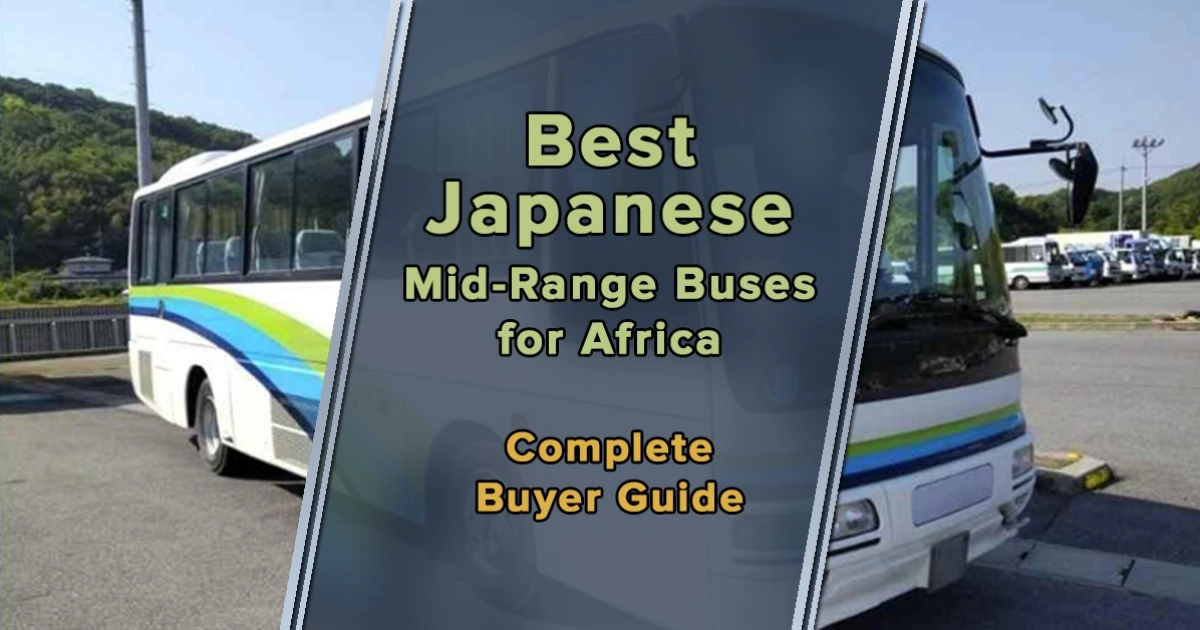
Importing the right bus for Africa is not as straightforward as it may seem. Japan produces some of the finest buses in the world, but not all of them are built for the same purpose — and choosing the wrong type for the roads and conditions in your country can turn what looks like a good investment into an expensive problem.
Many buyers focus on the well-known names — the Hino Selega, Isuzu Gala, Mitsubishi Fuso Aero Ace — and assume that a premium Japanese coach will be a premium choice for Africa too. In most cases, that assumption is wrong. These are highway coaches engineered for Japan's smooth motorway network, and they come with a set of characteristics that make them far less suitable for the unpaved roads, remote routes and limited repair infrastructure found across much of Africa.
The sweet spot for most African operators lies in what the industry calls the mid-range bus — roughly 29 to 47 seats, step-entrance design, higher chassis, simpler mechanics. This guide explains exactly which mid-range Japanese buses are worth considering, what makes each one right or wrong for African conditions, and what to watch out for when importing.
Note: This guide focuses specifically on mid-range buses in the 29 to 49 seater category. Micro buses such as the Toyota Coaster, Hino Liesse and Mitsubishi Rosa (25 to 29 seats) are a separate category and are not covered here.
Why Large Highway Coaches Struggle on African Roads
To understand why mid-range buses are the better choice for Africa, it helps to first understand what large highway coaches are actually designed for — and what they are not.
Buses like the Hino Selega, Isuzu Gala, Mitsubishi Fuso Aero Ace and Aero Queen are premium long-distance coaches built specifically for Japan's expressway network. They are optimised for speed, passenger comfort and fuel efficiency on smooth, well-maintained roads. They are remarkable vehicles — for the purpose they were designed for.
The challenges they present for African operators are significant:
- Lower ground clearance: Large highway coaches sit lower to the ground than mid-range buses. While the difference in ground clearance between a highway coach and a mid-range bus may not appear dramatic in millimetres, it becomes significant in practice when combined with the length of the vehicle, the positioning of low-mounted components such as the exhaust and air suspension, and the type of terrain they are expected to cross. On unpaved roads, rough terrain, deep ruts and steep ramps, the undercarriage and air suspension components of a long highway coach are considerably more vulnerable to damage than those of a shorter, higher-sitting mid-range bus.
- Complex electronics and ADAS systems: Modern highway coaches are packed with advanced driver assistance systems — lane departure warnings, collision mitigation braking, electronic stability control and more. These systems require specialised diagnostic equipment and trained technicians to maintain and repair. Outside of major cities, this infrastructure is rarely available.
- Air suspension: Most large coaches use air suspension for passenger comfort. While excellent on smooth roads, air suspension systems require regular maintenance and specialist parts that are difficult to source and expensive to replace in many African markets.
- Limited local technician experience: Mechanics with experience on large highway coaches are far less common in Africa than mechanics familiar with mid-range buses or trucks.
None of this makes a large coach a bad bus. It makes it the wrong bus for the wrong road. On well-paved intercity highways between major African cities, a large coach can perform well. But for the majority of routes across rural Africa, a mid-range bus is the more practical, more durable and more cost-effective choice.
What Makes a Mid-Range Bus Right for Africa
The mid-range Japanese bus occupies a very practical position — large enough to be commercially viable, but built with a robustness and simplicity that makes it far better suited to the demands of African roads and operating environments.
- Step-entrance design and ground clearance: Mid-range buses suited for African roads use a step-entrance design, where passengers climb steps from ground level into the main passenger cabin. The floor sits higher, resting on top of the wheel arches — and it is this higher floor and chassis position that provides greater clearance beneath the vehicle where the engine, transmission, axles and exhaust are located. This is in contrast to low-floor designs such as city buses, where the floor sits as close to the ground as possible for easy boarding — a design that significantly reduces ground clearance and makes them unsuitable for rough or unpaved roads.
- Simpler mechanical systems: Mid-range buses use fewer advanced electronics and driver assistance systems compared to modern highway coaches. Fewer systems means fewer things that can go wrong, and fewer specialist tools and skills needed to repair them.
- Easier roadside repairs: When a breakdown occurs on a remote route, the ability to diagnose and repair the problem on the side of the road — or at a local workshop — can be the difference between a manageable delay and a serious operational crisis.
- Robust components relative to their size: Some mid-range buses, particularly certain Mitsubishi Fuso models, use drivetrain components shared with much larger buses — meaning the brakes, suspension and axles are effectively overbuilt for the passenger load they carry.
The Mid-Range Japanese Bus Landscape
Over the years, only a small number of mid-range bus models have been produced by the three main Japanese bus manufacturers. What many buyers do not realise is that most of these models are no longer in production. If you are importing a used mid-range Japanese bus today, you are most likely importing a vehicle that has not been manufactured for several years — and in some cases, for over two decades.
| Bus Model | Manufacturer | Production Status | Notes |
|---|---|---|---|
| Fuso Aero Midi | Mitsubishi Fuso | Discontinued 2017 | All variants ended production in 2017 |
| Isuzu Journey-Q | Isuzu | Discontinued 2001 | MR/GR series ended in 2001 |
| Hino Melpha | Hino | Still in production | Manufactured at J-Bus plant in Japan |
| Isuzu Gala Mio | Isuzu | Still in production | Manufactured at J-Bus plant in Japan |
The practical implication of this for African buyers is straightforward: if you want a used mid-range Japanese bus, your reliable options today are the used Mitsubishi Fuso Aero Midi, or a used or newer unit of the Hino Melpha or Isuzu Gala Mio. Everything else in this category has been out of production for a considerable time, and while good condition units may occasionally appear in the market, finding a reliable one consistently is increasingly difficult.
First Choice: Mitsubishi Fuso Aero Midi
Why the Aero Midi is the Top Recommendation for Africa
A good condition used Mitsubishi Fuso Aero Midi remains the single best option for most African operators, and has been for many years. This is not simply a matter of price or availability — it comes down to a combination of factors that make it uniquely well suited to African operating conditions.
The Fuso brand has a long and well-established reputation across Africa, built largely through the widespread use of the Fuso Canter truck. Decades of Canter trucks operating across the continent means that Fuso engines, drivetrains and components are familiar to mechanics in many African countries. When an Aero Midi breaks down, finding someone with the knowledge and experience to repair it is far more realistic than with many other buses. This is a practical advantage that is easy to underestimate until the moment you need it.
Beyond the parts and service network, the Aero Midi's step-entrance, higher-chassis design gives it excellent ground clearance that protects the engine, transmission and undercarriage on rough roads. Its mechanical systems are robust and relatively straightforward compared to modern highway coaches, and its overall build quality reflects the ruggedness that Mitsubishi Fuso is known for across heavy commercial vehicles.
MK Series — The Most Common Version
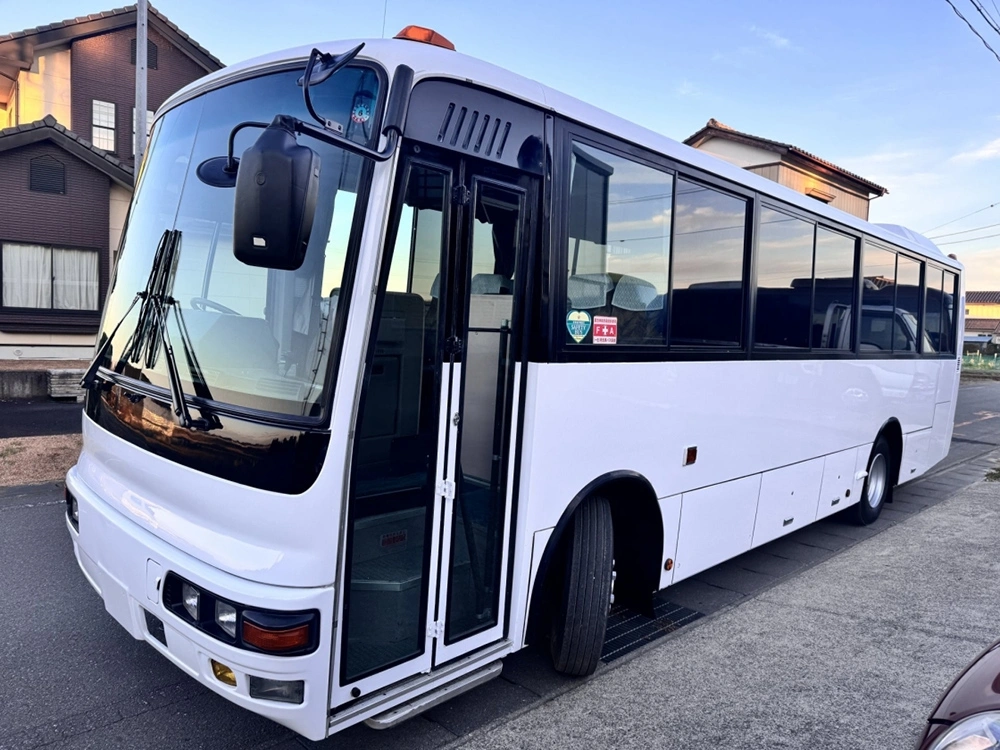
The Mitsubishi Fuso Aero Midi MK series is a durable medium-duty bus produced by Mitsubishi Fuso since 1988, ranging in length from 7.0 to 10.1 metres and serving as a city bus, shuttle bus and small coach across many markets. It is the most widely recognised version of the Aero Midi and the most commonly found on African roads. The common chassis codes for the MK series are MK117, MK219 and MK25.
The MK series has been the benchmark for mid-range bus imports to Africa for many years. Its step-entrance design keeps the engine and transmission high enough to avoid damage from rocks and deep ruts — a characteristic that operators across Africa have come to rely on.
MM Series — The Hidden Gem
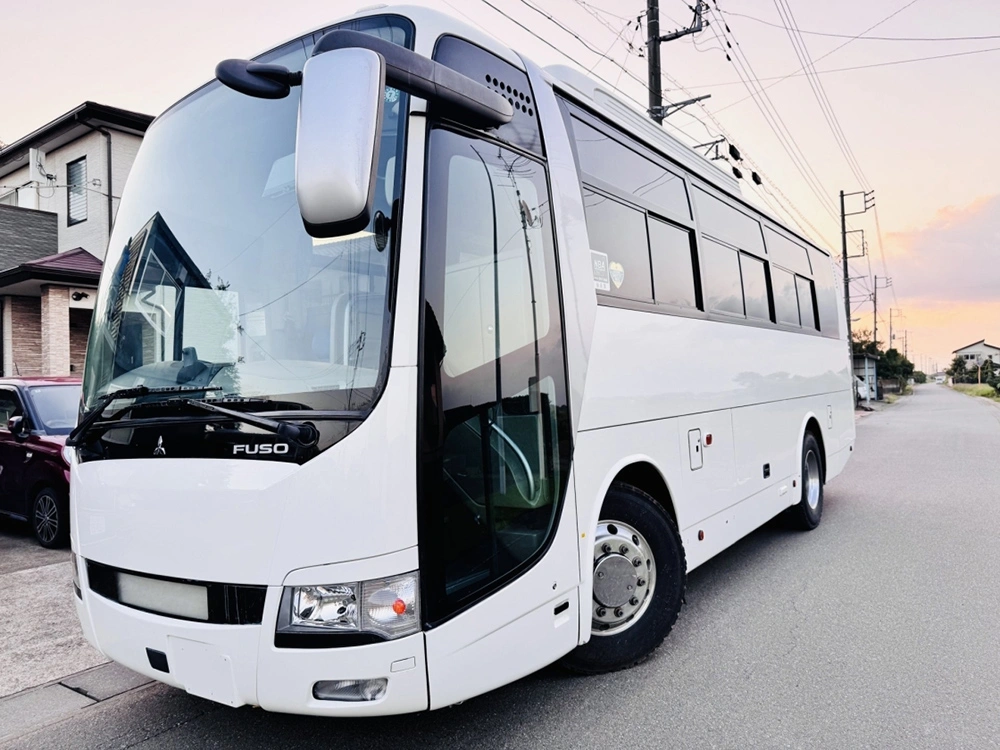
Less well known than the MK, the MM series is something of a hidden gem for African buyers. While it shares the same approximate length as the MK series, it uses the wider body and heavier components of a full-sized bus — approximately 2.5 metres wide compared to the MK's 2.3 metres, and fitted with the engine and axles from the larger Aero Star or Aero Ace Bus, including the heavy-duty 6M series or 6D24 engine. This means the brakes, suspension and drivetrain are effectively overbuilt for a 35-seater, giving it a significant durability advantage in demanding conditions. Its wider stance also provides better stability on cambered and uneven dirt roads. The chassis codes for the MM series are MM86 and MM96.
If you find a good condition MM series Aero Midi, it is widely considered the most rugged and capable mid-range Japanese bus option for African road conditions.
MK Series vs MM Series — Quick Comparison
| Feature | Aero Midi MK Series | Aero Midi MM Series |
|---|---|---|
| Body Width | ~2.3m (standard midibus) | ~2.5m (full-size bus width) |
| Engine | Medium-duty (6D series) | Heavy-duty (6M series / 6D24) |
| Road Stability | Good | Excellent — better for cambered and uneven roads |
| Seating Capacity | 25 to 57 seats depending on configuration • Luxury/Salon: 25~29 • Standard Touring: 37~47 • High-Density/Shuttle: 54~57 (with auxiliary aisle seats) |
28 to 42 seats depending on configuration • Luxury/Salon: 28~29 • Standard Touring: 33~35 • High-Density: up to 42 |
| Parts | Common midibus parts | Shared with full-size Fuso buses |
| Chassis Codes | MK117, MK219, MK25 | MM86, MM96 |
| Verdict | Solid and proven choice | The "tank" — most rugged chassis of the two |
Important: Production Ended in 2017 — The Late Registration Warning
All production of the Mitsubishi Fuso Aero Midi ended in 2017. This is something every buyer must understand before searching for one.
You may come across Aero Midi buses advertised with a registration year of 2019 or even 2020. This does not mean the bus was manufactured in those years. In Japan, a vehicle can be manufactured in one year and officially registered for road use in a later year — this is known as late registration. Buses were sometimes held in stock after production ended and registered when they were eventually put into service.
Buying Advice — Condition Matters More Than Price
Good condition Aero Midi buses are still available in Japan, but the supply of well-maintained units is gradually tightening as the vehicles age. This makes condition the single most important factor when selecting an Aero Midi.
A bus in poor condition may appear to be a bargain at the point of purchase, but the cost of repairs, delays and operational downtime once it arrives can far exceed any initial saving. Some operators have experienced situations where an exporter accepts an order and advance payment, only to discover during the pre-shipment inspection that the vehicle's condition is far worse than expected — resulting in delays, renegotiations or even cancellation of the order.
Key advice: Choose an exporter with genuine experience in buses specifically — not just cars or general used vehicles. An experienced bus exporter will have a realistic understanding of the condition of what they are offering before they quote you. If the price of an Aero Midi looks unusually cheap compared to the market, there is usually a reason. A low price is a warning signal, not a bargain.
Second Choice: Hino Melpha or Isuzu Gala Mio
If a good condition Aero Midi cannot be found, or if you prefer the assurance of a bus that is still in production with genuine parts readily available, the Hino Melpha and Isuzu Gala Mio are the recommended alternatives. They are equal in recommendation — the choice between them comes down entirely to which brand has stronger parts availability and service support in your specific country.
The J-Bus Connection — Same Vehicle, Two Badges
What most buyers do not know is that the Hino Melpha and the Isuzu Gala Mio are built on exactly the same platform, through the J-Bus manufacturing joint venture between Hino and Isuzu in Japan. They share the same basic chassis, the same engine family and virtually identical ground clearance. Mechanically, they are the same bus wearing different manufacturer badges.
This is important because it means there is no technical reason to strongly prefer one over the other. The deciding factor for an African operator should always be: which brand has better parts availability and a stronger service network in my country?
Shared Specifications
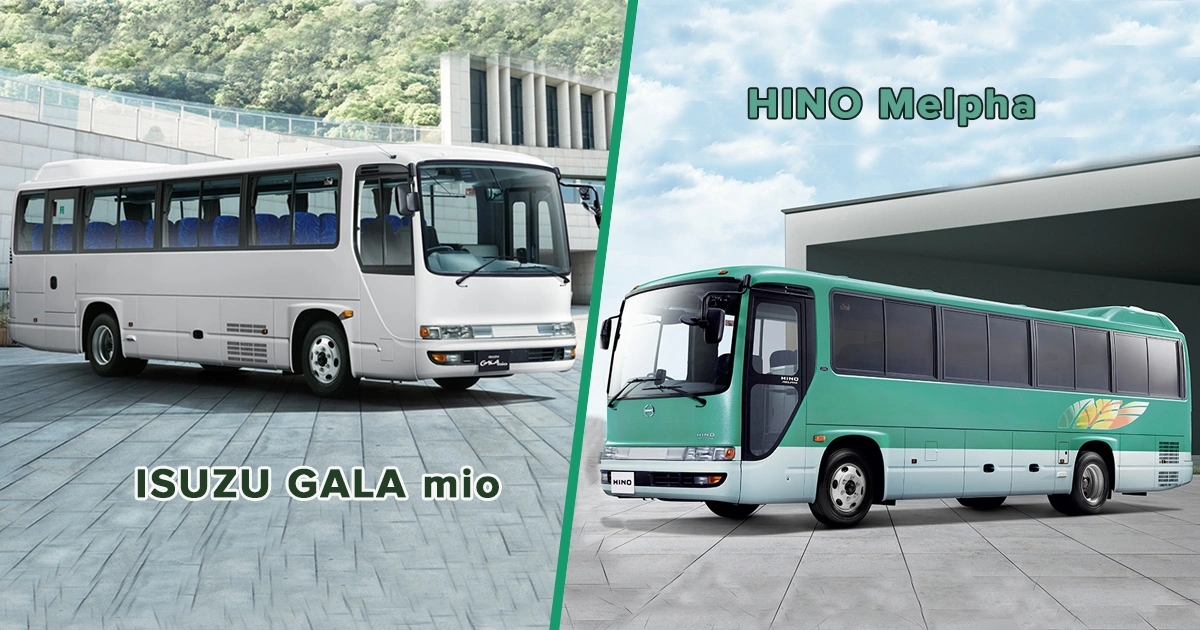
- Ground clearance: Approximately 210mm — excellent for mixed road conditions including semi-paved and unpaved routes
- Layout: Rear-engine design — robust and favoured for durability in demanding conditions
- Engine: Both use engines from the same Hino engine family, world-renowned for reaching high mileage with minimal breakdowns
- Production status: Both still in production — genuine new parts are readily available from authorised dealers
- 2015 and newer models: Include collision mitigation braking and improved fuel efficiency
Parts and Service
Because the Melpha and Gala Mio share the same chassis and engine family, mechanical parts are generally compatible between the two. However, body panels and interior parts may differ between models and should always be sourced specifically for each bus. Always confirm the exact model when ordering body or interior components.
The most significant advantage of both models over the Aero Midi is that they are still in production. This means genuine manufacturer parts are available through the official dealer network, rather than relying on the used parts market.
Hino Melpha — Model Notes
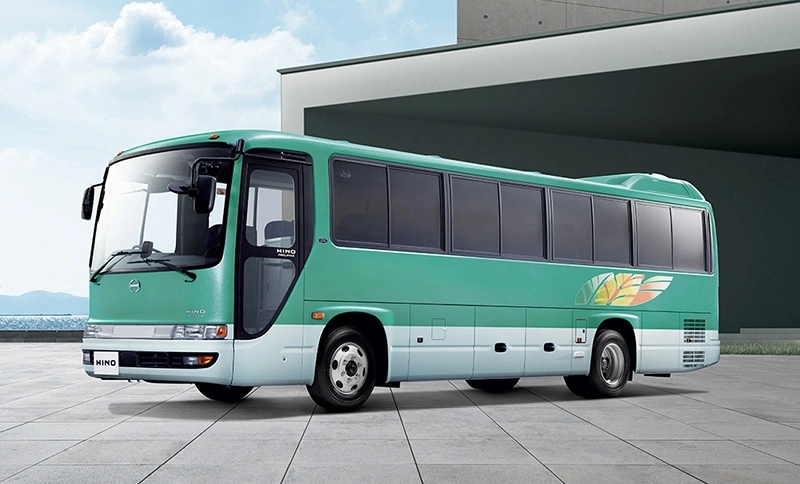
- Look for the RR series (for example, RR7J) for the most rugged versions
- Strong Hino dealer network established in many African countries
- Hino is a Toyota Group company — a further assurance of long-term parts support
Isuzu Gala Mio — Model Notes
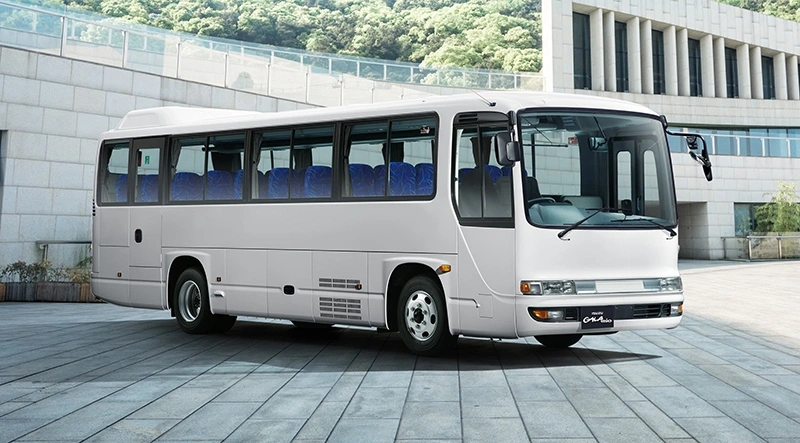
- Natural choice for countries where Isuzu has a stronger dealer and parts presence than Hino
- Same ground clearance, engine durability and chassis design as the Melpha
- Where Isuzu commercial vehicles are well established in the market, the Gala Mio benefits from the existing service and parts infrastructure
Critical warning — Gala Mio vs Erga Mio: Do not confuse the Isuzu Gala Mio with the Isuzu Erga Mio. The Erga Mio is a low-floor city bus designed for urban use in Japan. It has very low ground clearance and is completely unsuitable for unpaved roads or rough terrain. The Gala Mio is a step-entrance intercity coach with high ground clearance. Always confirm the exact model name when browsing listings — the difference between these two models is not obvious from the name alone.
A Note on Modern Bus Technology
While older, simpler buses remain the practical preference for many African operators today, it is worth acknowledging that the automotive world is not standing still. Systems like AdBlue, collision mitigation braking and improved fuel management are becoming the new standard — not just in Japan but globally. These technologies are increasingly unavoidable as the Japanese used vehicle market shifts toward newer generations of buses.
These systems are not inherently problematic. In most cases, issues only arise when regular maintenance, oil changes and scheduled servicing are neglected. An operator who maintains their bus correctly will rarely encounter serious problems with modern electronic systems — the same discipline that kept older buses running reliably applies equally to newer ones.
The African operator who begins adapting to these modern systems now will be better positioned as the used bus market inevitably moves in this direction. Investing in the knowledge and workshop capability to support these technologies today is a practical step toward long-term operational resilience.
Which Bus Should You Choose?
The right choice depends on what is available, your budget, the roads you will be operating on, and the parts and service infrastructure in your country. Here is a practical summary:
| Your Situation | Recommended Choice |
|---|---|
| Best overall for African conditions | Used Fuso Aero Midi MM Series & MK Series (good condition) |
| Cannot find good condition Aero Midi | Hino Melpha or Isuzu Gala Mio |
| Country with strong Hino dealer network | Hino Melpha (RR series) |
| Country with strong Isuzu dealer network | Isuzu Gala Mio |
| Prefer a newer bus with modern safety features | Hino Melpha or Isuzu Gala Mio (2015 or newer) |
Choose Fuso Aero Midi if:
- You can find a good condition unit
- Fuso technicians are established in your country
- You are operating on very rough or unpaved roads
- You prefer the ruggedness of a step-entrance higher-chassis design
- You want the most proven choice for African conditions
Choose Hino Melpha or Isuzu Gala Mio if:
- Good condition Aero Midis are not available or too expensive
- You want a bus still in production with genuine parts support
- You prefer a newer bus with modern safety and fuel efficiency features
- Hino or Isuzu has a stronger dealer network in your country
Looking for Japanese Mid-Range Buses?
At Elegant Import & Export, we are a fully licensed Japanese vehicle exporter with over 20 years of experience — including extensive experience in exporting buses to Africa and other markets worldwide. We source Mitsubishi Fuso Aero Midi, Hino Melpha and Isuzu Gala Mio units and can advise you on condition, chassis codes and suitability for your specific market before you commit to a purchase.
Why Choose Us:
- Licensed Japanese vehicle exporter & member of USS, IAA and TAA auctions
- Over 20 years of industry experience
- Full vehicle details provided / easy to navigate website
- Handles pre-shipment inspection and all other related documentation
- Competitive FOB, C&F and CIF pricing
- Worldwide shipping to 90+ countries
Final Thoughts
Choosing the right bus for Africa is about more than finding the lowest price or the most impressive specifications. It is about matching the vehicle to the roads it will travel, the technicians who will maintain it, and the operating environment it will face every day. A bus that performs brilliantly in Japan can be a serious liability on an unpaved African road — and a bus that looks modest on paper can prove itself an exceptional workhorse for decades.
The used Fuso Aero Midi, the Hino Melpha and the Isuzu Gala Mio each represent a well-considered answer to the specific demands of African bus operation. If you take one piece of advice from this guide, let it be this: prioritise condition and the experience of your exporter over price. A well-sourced bus from a knowledgeable exporter will always deliver better value over its lifetime than a cheap bus from someone who does not fully understand what they are selling.
Looking for a Japanese mid-range bus for Africa? Browse our current bus stock or contact us directly — our team has over 20 years of experience exporting buses to Africa and can advise on the right model and condition for your specific market. View Bus Stock ›
Frequently Asked Questions
What is the difference between a mid-range bus and a large coach?
Large coaches are typically larger vehicles designed for long-distance highway travel, capable of accommodating more passengers and offering a higher level of onboard comfort. Models such as the Hino Selega, Isuzu Gala and Mitsubishi Fuso Aero Ace or Aero Queen are built for expressway use and feature advanced electronics, air suspension and modern driver assistance systems. Mid-range buses are smaller, generally seating between 29 and 47 passengers, and are designed for regional, intercity and mixed-route operations. Both large coaches and mid-range intercity buses feature a step-entrance design. However mid-range step-entrance buses tend to have a slight advantage in ground clearance over large coaches, primarily because their shorter length makes them more manageable on roads that are uneven, cambered or unpaved.
Is the Mitsubishi Fuso Aero Midi still being manufactured?
No. All production of the Mitsubishi Fuso Aero Midi ended in 2017. It is only available as a used vehicle. Buyers should be aware that a vehicle advertised with a 2019 or 2020 registration year may have been manufactured earlier — late registration is common in Japan, meaning a bus can be built in one year but officially registered much later.
What is the difference between the Aero Midi MK series and the MM series?
The primary difference between the Mitsubishi Fuso Aero Midi MK series and the MM series lies in their chassis design and intended application. While both are medium-sized buses, they cater to different operational needs.
MK Series: Uses a monocoque design with a rear-mounted engine. While modern versions have sophisticated air suspension, earlier and more budget-friendly models often used leaf springs, making them durable and practical for transit roles.
MM Series: Originally designed as a full-sized large bus shortened to midibus length. Unlike the standard MK, the MM series featured air suspension as standard from its early days to provide the ride quality expected of a luxury touring coach. This also means the MM series uses heavier-duty components — engine, axles, brakes and suspension — shared with the larger Aero Star and Aero Ace Bus, making it exceptionally robust relative to its size.
If production of the Aero Midi ended in 2017, why do some listings show more recent registration years?
In Japan, the registration year of a vehicle does not always correspond to its manufacture year. A bus can be manufactured in one year and officially registered for road use in a later year — this is known as late registration. Because the Aero Midi was popular and units were held in stock, some vehicles manufactured before the 2017 production end were registered in subsequent years.
What is the difference between the Isuzu Gala Mio and the Isuzu Erga Mio?
These are two completely different buses. The Isuzu Erga Mio is a low-floor city bus designed for urban use, with very low ground clearance that makes it entirely unsuitable for unpaved or rough roads. The Isuzu Gala Mio is a step-entrance intercity coach with approximately 210mm of ground clearance, making it suitable for mixed road conditions. African bus buyers must confirm the exact model name when browsing listings to avoid importing the wrong vehicle.
Are the Hino Melpha and Isuzu Gala Mio the same bus?
They are built on the same integrated platform through the J-Bus manufacturing joint venture between Hino and Isuzu, and share the same basic chassis, engine family and ground clearance of approximately 210mm. Mechanically they are virtually identical. However body panels and interior parts may differ between the two and should be sourced specifically for each model. When choosing between them, the deciding factor for African buyers should be which brand has stronger parts availability and service network in their specific country.
Which Japanese mid-range bus is best for African roads?
A good condition used Mitsubishi Fuso Aero Midi — particularly the MM series — is considered the best overall choice for African roads. Its step-entrance high-chassis design provides excellent ground clearance, its components are robust and well-proven in African conditions alongside the Fuso Canter truck, and experienced Fuso technicians are already established in many African countries. If a good condition Aero Midi (MM or MK) cannot be found, the Hino Melpha or Isuzu Gala Mio are the recommended alternatives, as both are still in production and offer approximately 210mm ground clearance with genuine parts availability.