By : Editorial Department of Elegant Import & Export Co., Ltd.
High Deck vs Just-Low vs Full Flat Low: Japanese Truck Guide
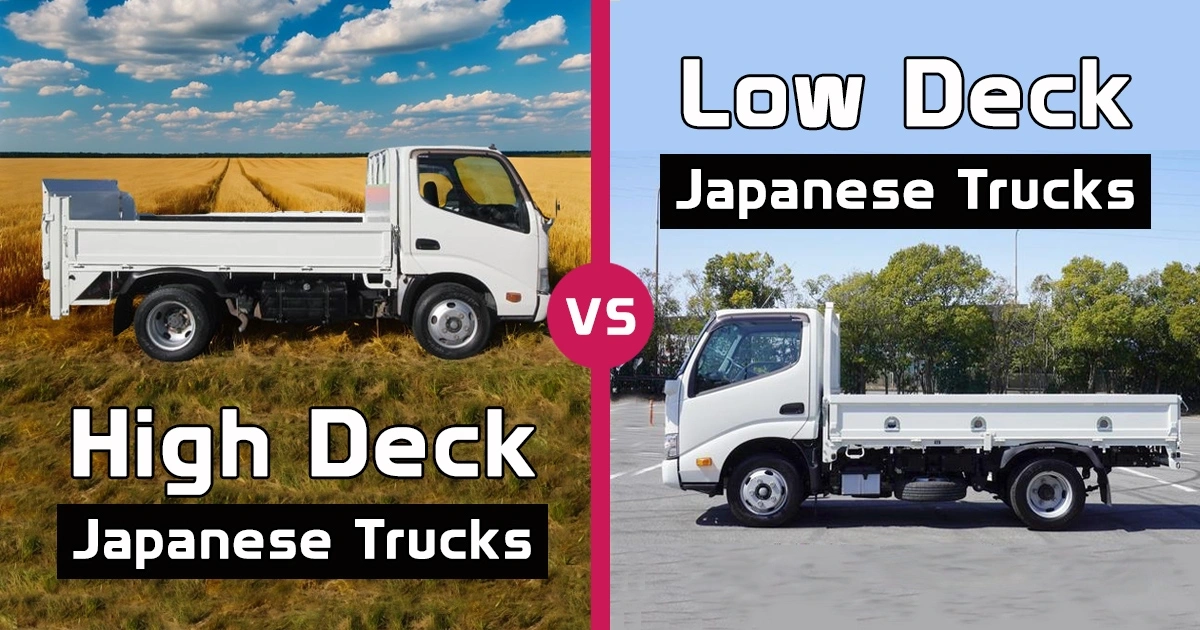
When buying a Japanese used truck, one of the most important decisions you will make is choosing the right deck type. Most exporters and stock listings will categorise trucks simply as High Deck or Low Deck — and for most buyers that is where the explanation ends.
What many listings will not tell you — and what even some less experienced exporters may not be aware of — is that there are actually two distinct types of Low Deck truck: Just-Low and Full Flat Low. This is why, if you look closely, some Low Deck trucks have the same size wheels on all four axle positions, while other Low Deck trucks have noticeably larger wheels at the front than at the rear. They are both listed as Low Deck, but they are built differently and have different practical implications for the buyer.
Understanding this difference before you purchase could save you from an unpleasant surprise when the truck arrives.
Quick Comparison at a Glance
| Feature | High Deck | Just-Low / Flat Low | Full Flat Low |
|---|---|---|---|
| Deck Height | High | Lowest | Low overall — lower ground clearance than Just-Low but higher rear deck than Just-Low |
| Front Tyre Size | Large | Large | Small |
| Rear Tyre Size | Large (same as front) | Small (different from front) | Small (same as front) |
| Spare Tyres Needed | 1 spare | 2 spares (different sizes) | 1 spare |
| Leaf Spring Type | Typically overslung (above axle) — varies by model | Varies by manufacturer and model | Underslung (below axle) |
| Ground Clearance | Highest | Lowest | Moderate |
| Loading Ease | Harder (higher lift required) | Easiest | Easy |
| Terrain Suitability | Paved & unpaved roads | Paved city roads recommended | Paved city roads recommended |
| Best Markets | Africa, SE Asia, rural areas | Urban deliveries | Urban logistics |
Understanding Deck Height vs Ground Clearance
Before we look at each deck type in detail, there is an important distinction worth understanding — one that is often misunderstood by buyers.
In the Japanese truck market, the terms High Deck and Low Deck refer primarily to the height of the cargo floor from the ground — that is, how high or low the loading surface sits. This is not the same as ground clearance, which is the distance between the lowest point of the vehicle's undercarriage and the road surface.
In many cases there is a natural relationship between the two — a High Deck truck with large uniform tyres will typically also have higher ground clearance, and a Low Deck truck with smaller rear tyres will typically have lower ground clearance. This is why the general advice of "High Deck for rough roads, Low Deck for city use" holds true in most situations.
However the two are not the same thing, and exceptions exist:
- High cargo floor, low ground clearance: Some high-deck light-duty trucks are designed for dock loading or urban logistics, where the cargo floor is kept elevated for loading efficiency but the overall chassis sits relatively low for stability and dock access. These trucks have a high cargo floor but are not designed for rough terrain.
- Specialized transport vehicles: Certain trailer and logistics configurations offer a high cargo deck height for maximum cargo volume, while maintaining low ground clearance by design — such as specific step-deck or low-profile transport vehicles built for controlled environments.
Key point for buyers: When your exporter mentions High Deck or Low Deck, they are most commonly referring to the cargo floor height. If ground clearance is critical for your roads — for example if you are importing to a market with unpaved roads — always specifically ask your exporter to confirm the ground clearance and tyre configuration of the specific truck, not just the deck type label. The deck type label is a useful guide, but it does not replace checking the actual specifications.
1. High Deck
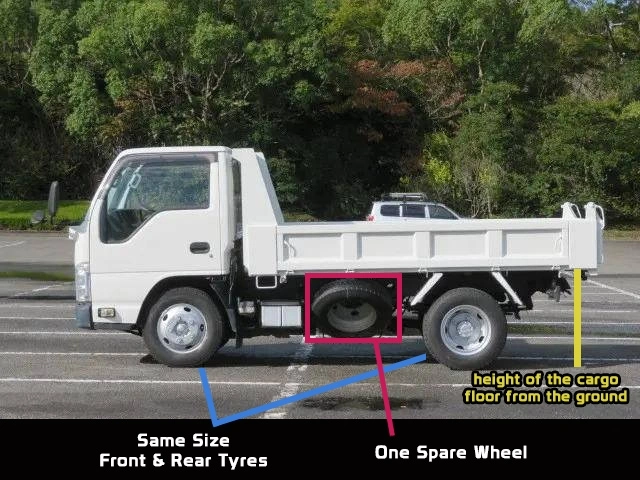
High Deck is the most traditional and widely used deck configuration for Japanese trucks exported to Africa, Southeast Asia, and markets with challenging road conditions. As the name suggests, the chassis sits at a higher position from the ground than either of the low deck variants.
High Deck and Standard Deck — the same thing: In Japan, the term Standard Deck is also widely used to describe the same configuration. When browsing Japanese used truck listings you may see either "High Deck" or "Standard Deck" — both refer to exactly the same truck setup. The term Standard Deck reflects that this was historically the default configuration before Low Deck variants were introduced.
A note on the "Super" term in trucks vs buses: In the bus world, Super High Deck (SHD) refers to an extra-tall passenger cabin — but this does not apply to trucks. In Japanese trucks, the "Super" label describes the cab (driver's area), not the cargo deck. On heavy-duty trucks like the Mitsubishi Fuso Super Great, "Super High Roof" refers to an extra-tall cabin that allows the driver to stand up inside comfortably. When you see "Super" on a truck listing, it refers to the driver's cab height — not the cargo deck height.
Tyre Configuration
High Deck trucks use large diameter tyres of the same size on both the front and rear axles. This uniform tyre configuration is one of the key advantages of the High Deck — because all tyres are the same size, you only need to carry one spare tyre, which reduces the tools and storage space required on long hauls.
The large tyres also mean fewer rotations per kilometre compared to small tyres. This reduces tyre wear, lowers running costs over time, and makes the High Deck cheaper to maintain in the long run despite the higher purchase price.
Who Should Choose High Deck?
- Operators in Africa, rural Southeast Asia, Pacific Islands or any market with unpaved, potholed, or flooded roads
- Construction and heavy load applications where durability matters more than loading ease
- Buyers who want lower long-term running costs from uniform tyre sizing
- Operators who need maximum ground clearance to protect the axle and undercarriage
Recommendation: High Deck is the number one choice for African and rural Southeast Asian markets. The large tyres absorb road vibrations, protect cargo and the driver, and the uniform tyre size makes roadside maintenance simpler and cheaper. If your destination has unpaved roads, always choose High Deck.
2. Just-Low / Flat Low
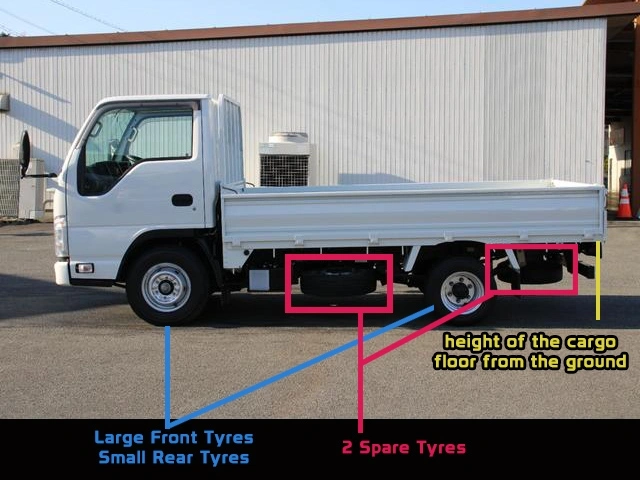
Just-Low — also widely known as Flat Low — is designed for urban delivery environments where drivers need to load and unload cargo by hand throughout the working day. It is the lowest deck configuration available and was specifically engineered to reduce the physical strain on drivers who are lifting heavy boxes repeatedly.
Just-Low and Flat Low: The Same Truck, Different Names
One of the most common points of confusion when browsing Japanese used truck listings is seeing different names for what is essentially the same truck configuration. Just-Low and Flat Low are exactly the same mechanical setup — the name simply varies by manufacturer and region.
| Manufacturer | Term Used | Common Models |
|---|---|---|
| Toyota | Just-Low | Dyna, Toyoace |
| Hino | Just Low / Low Profile (LP) | Dutro, 300 Series |
| Isuzu | Low-Flat / Flat-Low | Elf, N-Series |
| Mazda | Flat Low | Bongo |
| Nissan | Flat Low | Atlas |
Regardless of which name you see on a truck listing, the defining mechanical characteristic is the same — large front tyres and small rear double tyres. When you see any of these names, you are looking at the same type of truck.
Tyre Configuration
Just-Low trucks use large diameter tyres on the front axle and small diameter double tyres on the rear axle. It is this mismatch in tyre sizes that creates the signature dropped rear deck height. By fitting smaller rear tyres, the rear of the chassis physically sits closer to the ground. The difference in deck height may not appear dramatic, but for a driver loading heavy cargo by hand repeatedly throughout the day, even a few centimetres lower makes a real practical difference.
The important trade-off is that because the front and rear tyres are different sizes, you must carry two different spare tyres — one for the front and one for the rear. This takes up additional tool storage space on the truck and adds a small but real complexity to roadside maintenance.
Who Should Choose Just-Low?
- Urban delivery operators who load and unload cargo by hand multiple times per day
- Businesses transporting tall cargo that benefits from a lower loading point and maximum internal height
- Operations on well-paved city roads where ground clearance is not a concern
- Buyers for whom driver comfort and reduced physical strain is a priority
Important: Just-Low trucks are not suitable for unpaved roads. The low ground clearance means the axle and undercarriage are highly vulnerable to damage from road obstacles, speed bumps, steep ramps, and uneven surfaces. If your destination has any unpaved roads, choose High Deck instead.
3. Full Flat Low
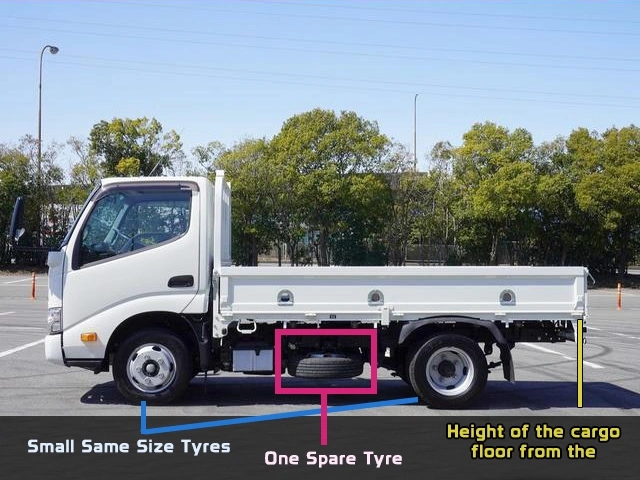
Full Flat Low is often described as the hybrid between High Deck and Just-Low — it delivers a low deck height for easy loading while solving the main maintenance inconvenience of Just-Low by using the same tyre size on all four wheels. It achieves this through a fundamentally different approach to the undercarriage design.
Tyre Configuration
Full Flat Low trucks use small diameter tyres of the same size on both front and rear axles. Because all tyres are uniform, you only need to carry one spare tyre — the same advantage as High Deck, but at a much lower deck height. This makes tyre management simpler and cheaper over the life of the truck.
This is where the comparison becomes interesting. Full Flat Low has lower overall ground clearance than Just-Low, because both axles use smaller tyres and the underslung spring pulls the entire chassis closer to the ground evenly. However, the rear deck height of a Full Flat Low is actually slightly higher than a Just-Low. On a Just-Low, the tiny rear tyres drop the rear of the chassis dramatically — more than the underslung spring effect on a Full Flat Low. The result is that Just-Low has the lowest rear loading point, while Full Flat Low has lower overall ground clearance across the whole vehicle.
Who Should Choose Full Flat Low?
- Urban operators who want a low loading height but simpler tyre management than Just-Low
- Fleet operators where standardising to a single spare tyre across the fleet reduces parts inventory
- Operations on well-paved city roads where ground clearance is not required
- Buyers who prioritise stable handling and low centre of gravity for urban logistics
How to Easily Identify a Truck's Deck Type
The most reliable and easily verified method is to inspect the tyre configuration. This is something you can check visually on any truck:
- High Deck: Same size tyres on both the front and rear axles. The truck sits high from the ground with good ground clearance.
- Just-Low / Flat Low: Visibly smaller tyres on the rear axle compared to the front axle. This mismatch is the defining feature and is easy to spot by simply looking at the wheels side by side.
- Full Flat Low: Same size tyres on both the front and rear axles — similar to High Deck in this regard. The key difference is that the overall chassis sits noticeably lower to the ground than a High Deck truck despite having uniform tyres.
Simple identification guide: Look at the rear tyres compared to the front tyres. If the rear tyres are visibly smaller than the front, it is Just-Low. If all four tyres are the same size but the truck sits low, it is most likely Full Flat Low. If all four tyres are the same size and the truck sits high, it is High Deck. Always confirm the deck type with your exporter before purchasing.
A Note on Leaf Springs and Suspension
You may hear the terms overslung and underslung leaf spring when researching Japanese truck deck types. These refer to whether the leaf spring is mounted above or below the rear axle, and they do have an influence on the chassis height and ride characteristics of the truck.
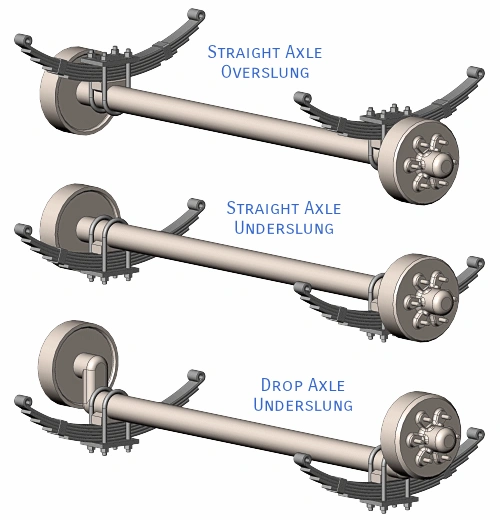
As a general guide — an overslung spring (mounted on top of the axle) tends to raise the chassis, and is more commonly seen on High Deck trucks. An underslung spring (hanging below the axle) tends to lower the chassis, and is more commonly seen on Full Flat Low and Just-Low trucks. The spring configuration varies by manufacturer and model, as the higher or lower deck height is achieved primarily through the tyre size rather than the spring position alone.
Generally trucks will have either leaf springs or air suspension — air suspension replaces the metal springs with air bellows (airbags) to handle the load and cushioning. However some setups, particularly on heavy-duty trucks, may use a hybrid system where airbags are added alongside existing leaf springs as a "helper kit" for extra stability and load leveling. The specific setup varies by manufacturer, model, year, and intended application, and suspension systems as a topic deserve a dedicated article of their own.
Which Deck Type Should You Buy?
The right deck type depends entirely on where the truck will be used and how it will be loaded. Here is a practical guide:
Choose High Deck if:
- Your roads are unpaved, potholed, or prone to flooding
- You are importing to Africa, rural Southeast Asia, or the Pacific Islands
- You carry heavy loads that benefit from large tyre stability
- You want the lowest long-term tyre running costs
- Ground clearance and axle protection are a priority
Choose Just-Low / Flat Low if:
- Your roads are well paved — city or urban use only
- Drivers load and unload by hand many times per day
- You carry tall cargo that benefits from maximum internal height
- The absolute lowest possible deck height is your priority
- You are prepared to carry two different spare tyres
Choose Full Flat Low if:
- Your roads are paved
- You want a low overall chassis with easy loading
- You prefer the simplicity of carrying one spare tyre
For urban logistics where tyre simplicity matters, Full Flat Low is the practical choice.
Looking for Japanese Used Trucks?
At Elegant Import & Export, we are a fully licensed Japanese vehicle exporter with over 20 years of experience. Our truck inventory includes High Deck, Just-Low and Full Flat Low configurations from leading Japanese manufacturers — all with verified specifications and worldwide shipping.
Why Choose Us:
- Licensed Japanese vehicle exporter & member of USS, IAA and TAA auctions
- Over 20 years of industry experience
- Full vehicle details provided / easy to navigate website
- Handles pre-shipment inspection and all other related documentation
- Competitive FOB, C&F and CIF pricing
- Worldwide shipping to 90+ countries
Final Thoughts
Understanding deck types is one of the most practical pieces of knowledge you can have when buying a Japanese used truck. Getting it right means your truck is well suited to your roads, your cargo, and your drivers. Getting it wrong means a truck that is either struggling on rough terrain or unnecessarily difficult to load every day.
As a simple rule — High Deck for rough roads, Just-Low for easy hand loading on paved roads, Full Flat Low for easy loading with simpler tyre management. When in doubt, contact your exporter and describe your roads and loading conditions — an experienced exporter will always be able to advise the right configuration for your market.
Looking for a Japanese used truck? Browse our current stock of High Deck, Just-Low and Full Flat Low trucks at competitive FOB prices, available for worldwide export. View Truck Stock ›
Frequently Asked Questions
High Deck trucks use large tyres of the same size on both the front and rear axles, which raises the chassis higher off the ground. This gives better ground clearance and makes them more suitable for unpaved and rough roads. Just-Low trucks use large tyres on the front but small double tyres on the rear, which physically drops the back of the chassis closer to the ground, making loading by hand much easier. The trade-off is lower ground clearance, making Just-Low trucks unsuitable for unpaved roads.
Yes, Just-Low and Flat Low refer to exactly the same truck configuration. The name differs by manufacturer. Toyota uses the term Just-Low on models like the Dyna and Toyoace. Hino uses Just Low or Low Profile (LP) on the Dutro and 300 Series. Isuzu uses Low-Flat or Flat-Low on the Elf and N-Series. Mazda and Nissan use Flat Low on the Bongo and Atlas respectively. Regardless of the name, the defining characteristic is the same — large front tyres and small rear double tyres, which drop the rear of the chassis closer to the ground. Leaf spring configuration can vary by manufacturer and model.
Full Flat Low uses uniform small tyres on all four wheels — this is its most consistent identifying characteristic. Many Full Flat Low trucks also use an underslung leaf spring, where the spring hangs below the axle at the same level as the bottom of the differential, helping to lower the chassis without mismatched tyre sizes. However not all Full Flat Low trucks use underslung springs — some achieve the same low deck height through a drop axle design, and some modern or specialised trucks use air suspension rather than mechanical leaf springs. The rear loading point is slightly higher than Just-Low, but Full Flat Low has lower overall ground clearance across the whole chassis. The key practical advantage over Just-Low is that uniform tyre sizes mean only one spare tyre is needed.
High Deck is strongly recommended for African markets and any destination with unpaved, rough, or flooded roads. The large uniform tyres provide better ground clearance, absorb road vibrations more effectively, and reduce the risk of axle damage from obstacles. Just-Low and Full Flat Low are designed for urban paved road use and their low ground clearance makes them vulnerable on rough terrain.
The simplest and most reliable way is to look at the tyre sizes. If the rear tyres are visibly smaller than the front tyres, it is Just-Low. If all four tyres are the same size, the truck is either High Deck or Full Flat Low — the difference between those two is the overall chassis height. Always confirm the deck type with your exporter before purchasing, as both Just-Low and Full Flat Low are often listed simply as Low Deck without further detail.
Just-Low trucks use different tyre sizes on the front and rear axles — large diameter tyres on the front and small diameter tyres on the rear. Because the sizes are different, one spare tyre cannot fit all four wheel positions. You need to carry one spare for the front and one spare for the rear. High Deck and Full Flat Low trucks both use uniform tyre sizes on all axles, so only one spare tyre is needed.
Not always. In the Japanese truck market, High Deck and Low Deck refer primarily to the height of the cargo floor, not necessarily to ground clearance. In most common cases there is a natural link — a High Deck truck with large uniform tyres will also have higher ground clearance. However some high-deck trucks are designed for dock loading or urban logistics, where the cargo floor is elevated for loading efficiency but the chassis sits relatively low for stability. If ground clearance is critical for your roads, always ask your exporter to confirm the actual ground clearance and tyre configuration of the specific truck, rather than relying on the deck type label alone.